
.png)
A tick bite may raise several different diagnostic questions. The key is to match each diagnostic need with the appropriate method.
Tick-borne diseases are becoming relevant to a broader range of European healthcare providers. Ticks capable of transmitting Lyme borreliosis and tick-borne encephalitis have been documented at increasingly northern latitudes and at higher altitudes.
Tick-borne encephalitis, however, remains geographically focal. European surveillance data show that areas with higher notification rates are currently concentrated mainly in Central, Eastern, and Northern Europe.
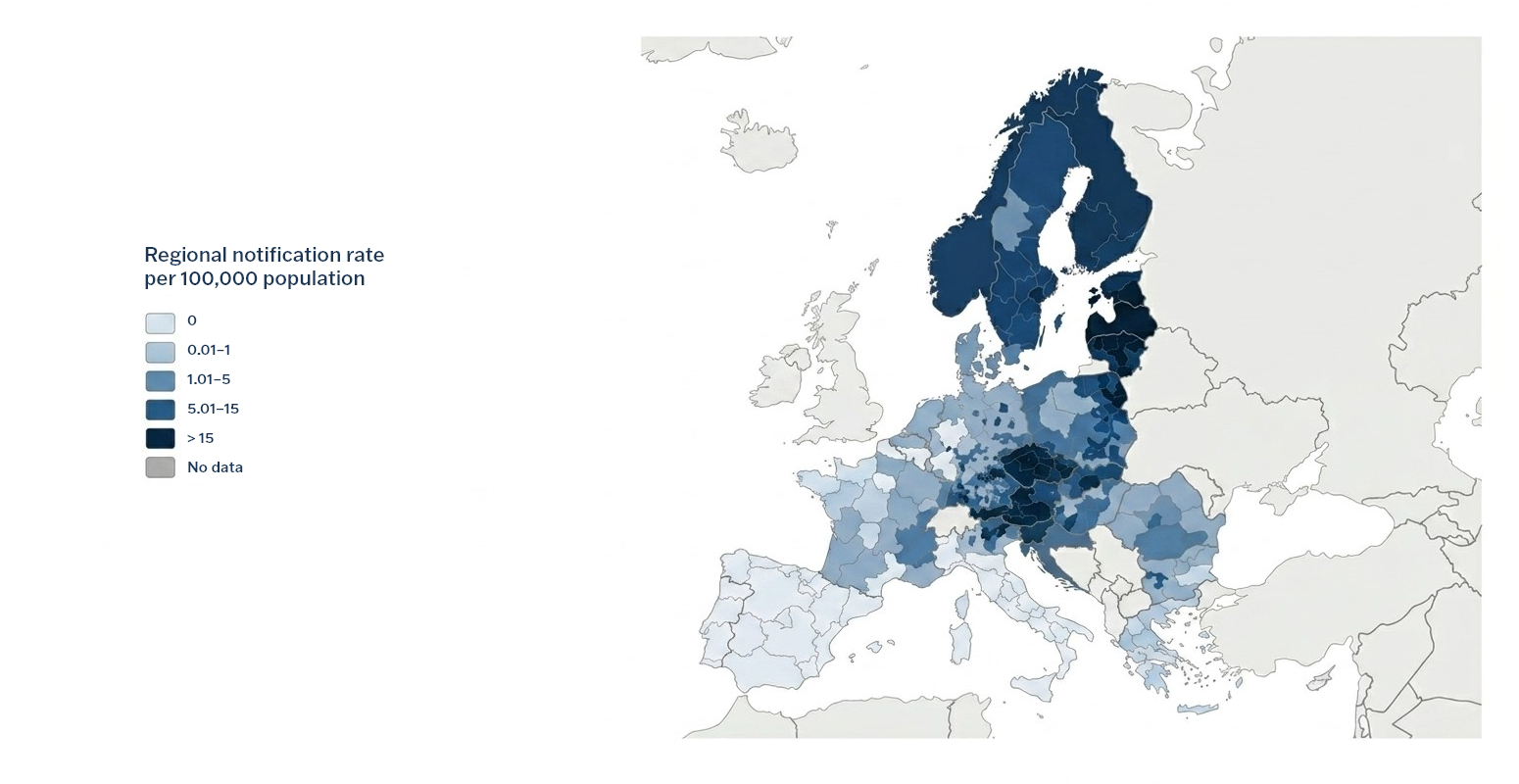
Fig. 1. Regional notification rates of locally acquired tick-borne encephalitis cases per 100,000 population in Europe, 2023. Higher notification rates are concentrated mainly in Central, Eastern, and Northern Europe.
European Centre for Disease Prevention and Control. Notification rates of locally acquired tick-borne encephalitis cases reported for 2023 [Internet]. Stockholm: ECDC; 2025 Apr 10 [cited 2026 Sep 2]. Available from: https://www.ecdc.europa.eu/en/publications-data/notification-rates-locally-acquired-tick-borne-encephalitis-cases-reported-2023
As tick-borne diseases become relevant across a wider geographic area, laboratories may encounter a broader range of clinical questions, sample types and testing requirements. For distributors, this makes it important to understand how a laboratory currently approaches diagnosis, which needs its workflow to address, and which methods could complement it.
In many clinical situations, a single test is not enough. The diagnostic pathway may need to distinguish between initial antibody testing, confirmation of reactive or borderline results, paired serum and cerebrospinal fluid testing, and more detailed assessment of reactivity to individual antigens.
One tick bite, several diagnostic questions
Detecting an antibody response is often only the beginning of the diagnostic process. What comes next depends on the nature of the finding and the clinical context. Is the antibody response consistent with Lyme borreliosis or TBE? Does a reactive or borderline Borrelia antibody result require confirmation? Could neurological symptoms indicate neuroborreliosis? How should previous TBE vaccination be taken into account when interpreting the results? Or should anaplasmosis also be considered?
The challenge is not simply to detect antibodies, but to obtain a clinically meaningful result that can be interpreted in the context of the suspected disease, clinical manifestations and patient history.
Table 1. Matching clinical questions with the appropriate BioVendor diagnostic solutions.
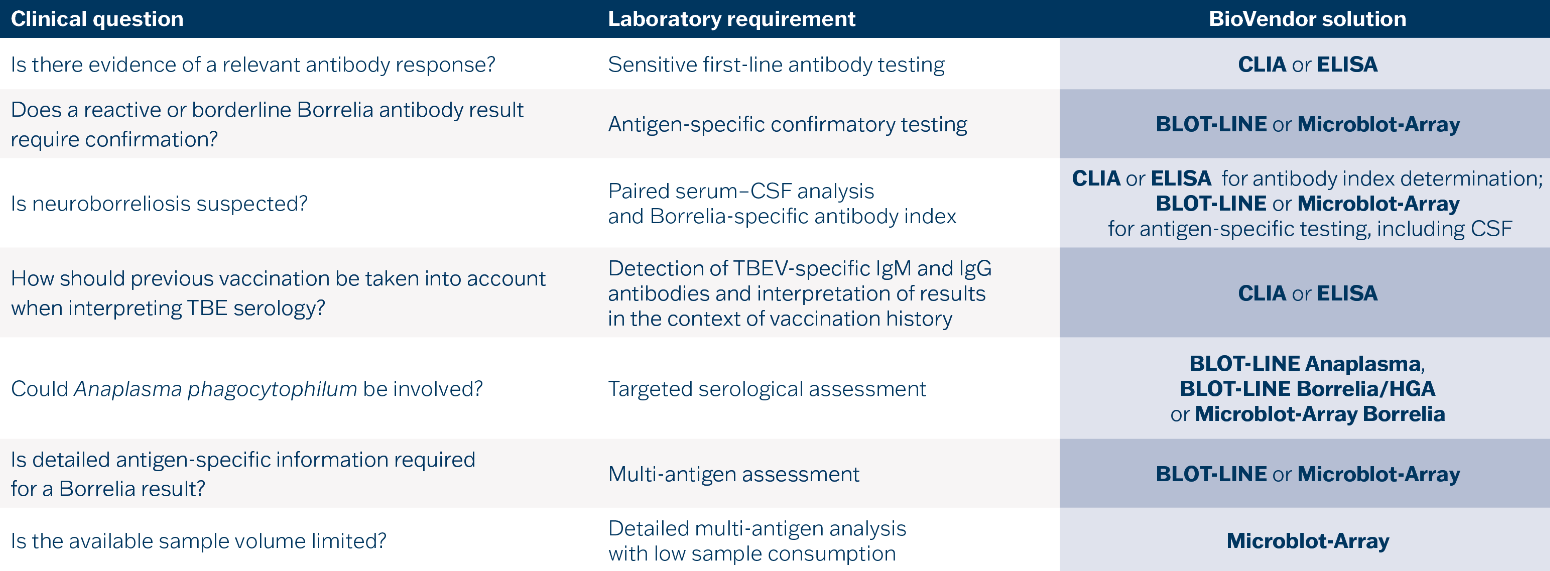
Different clinical questions place different demands on laboratory testing. By combining flexible or automated testing with antigen-specific confirmation and more detailed investigation, laboratories can select the method and level of information best suited to each diagnostic situation.
Lyme borreliosis: timing and context matter
The diagnostic value of serology changes over the course of Lyme borreliosis. Typical erythema migrans is primarily diagnosed on clinical grounds, and antibody tests may still be negative in the early stage of infection. In disseminated or later manifestations, serology becomes an important part of the diagnostic work-up but results still need to be interpreted in the context of the clinical findings and duration of illness.
When an initial immunoassay for Borrelia antibodies yields a reactive or borderline result, a more specific confirmatory test usually follows. This two-tier approach helps clarify findings that may be due to cross-reactivity and provides a more detailed basis for interpretation.
For laboratory diagnosis of Lyme borreliosis, BioVendor offers CLIA and ELISA for initial antibody testing, complemented by BLOT-LINE and Microblot-Array for antigen-specific confirmation and more detailed assessment of the antibody response.
When neuroborreliosis is suspected, routine serum antibody testing alone is not sufficient. Serum and cerebrospinal fluid should be collected at the same time to allow calculation of the Borrelia-specific antibody index together with assessment of inflammatory parameters in the CSF. This helps determine whether Borrelia-specific antibodies are being produced within the central nervous system.
Selected BioVendor CLIA and ELISA assays support this workflow by enabling antibody index determination from paired serum and CSF samples.
TBEV: when serology needs to consider more than antibody detection
Tick-borne encephalitis is a viral infection of the central nervous system and remains clinically relevant in endemic areas of Europe. Once neurological symptoms develop, diagnosis is based primarily on serology: specific IgM and IgG antibodies are usually detected in serum and, where indicated, in cerebrospinal fluid. Molecular methods have limited diagnostic value at this stage because viraemia generally precedes the neurological phase of the disease.
Interpretation can still be challenging. TBEV-specific IgM antibodies may persist, while IgG may reflect previous infection or vaccination. Cross-reactivity with antibodies to other flaviviruses may further complicate interpretation. A positive IgG result alone may therefore have limited diagnostic value in vaccinated populations.
Reliable interpretation requires IgM and IgG results to be assessed together with the patient’s vaccination history, the timing of sample collection and the clinical presentation.
For TBE serology, BioVendor offers CLIA and ELISA methods for the detection of IgM and IgG antibodies, including applications relevant to vaccinated populations and, where applicable, IgG avidity assessment.
Anaplasma: a targeted question within the workflow
Human granulocytic anaplasmosis often presents as an acute, non-specific febrile illness that can be difficult to distinguish clinically from other infections. Testing for Anaplasma phagocytophilum is therefore generally considered when the patient’s symptoms and history of a tick bite raise a specific suspicion of anaplasmosis, or when possible, co-infection with another tick-borne pathogen is being investigated. It is not necessarily included in every initial work-up for tick-borne disease.
For the serological assessment of selected cases, BioVendor offers BLOT-LINE Anaplasma IgG and IgM, combined BLOT-LINE Borrelia/HGA IgG and IgM assays, and Microblot-Array Borrelia with A. phagocytophilum antigens. Depending on the diagnostic question, these methods provide targeted or combined information on reactivity to individual antigens.
Because serology alone cannot establish a diagnosis of acute anaplasmosis, results should always be interpreted in the context of the stage of illness and the applicable diagnostic algorithm.
Build the workflow around the laboratory
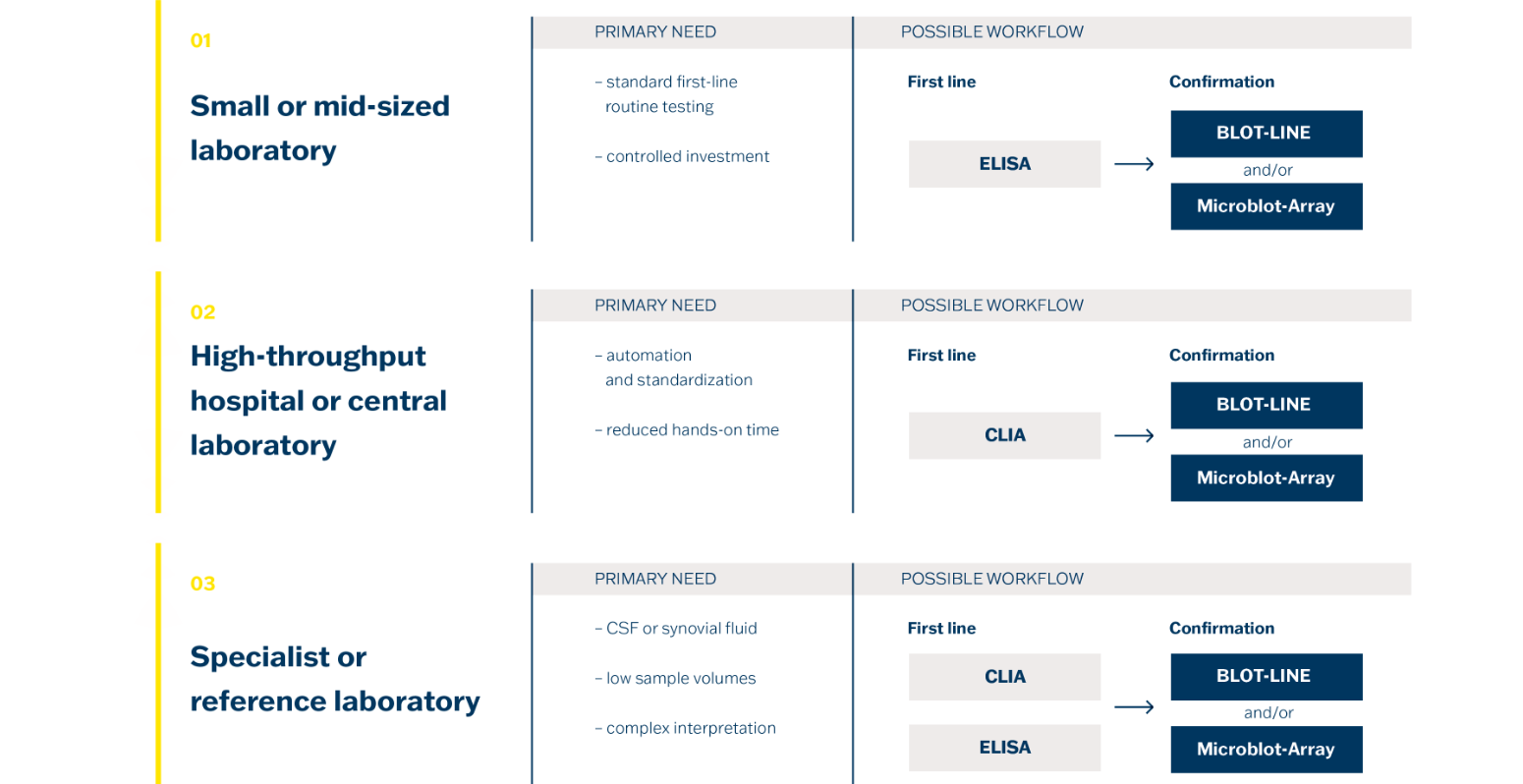
The most appropriate solution depends on more than the disease area. Laboratory workflow is also shaped by testing volume, available instrumentation, in-house expertise and the proportion of complex cases.
Table 2. Matching BioVendor solutions to laboratory profiles.
Build the right portfolio for your market
Review local diagnostic needs, testing practices and customer profiles with a BioVendor specialist to identify the most relevant kits.
Talk to our product specialist →
CLIA: automated initial antibody testing
For laboratories processing larger sample volumes, CLIA enables routine testing to be performed automatically, with walk-away operation, standardised processing and reduced hands-on time. It may be particularly beneficial for laboratories moving from manual or semi-automated ELISA to a more integrated, automated workflow.
Within the BioVendor portfolio, CLIA supports routine antibody testing for Borrelia and TBEV and can serve as the automated first step in a broader diagnostic workflow. Reactive or borderline Borrelia antibody results can subsequently be investigated using an appropriate confirmatory method. Selected CLIA assays can also be used to calculate the antibody index from paired serum and CSF samples when neuroborreliosis is suspected.
Explore BioVendor’s automated CLIA solution
ELISA: flexibility with existing laboratory equipment
ELISA remains an accessible option for many independent and hospital laboratories. It can make use of existing equipment, accommodate different batch sizes and be introduced without the need to invest in a fully automated platform.
For smaller and medium-throughput laboratories, ELISA can provide a practical first step towards a complete diagnostic service. Routine testing can remain flexible, while confirmation can also be introduced in-house instead of referring every reactive or borderline sample for external testing.
Explore ELISA kits for Borrelia and TBEV serology
BLOT-LINE: antigen-specific confirmation
BLOT-LINE provides antigen-specific information for assessing Borrelia IgM and IgG antibody responses. Its main role is the follow-up of positive or borderline results that require confirmation with differentiation of reactivity to individual antigens.
Selected BLOT-LINE assays include species-specific Borrelia antigens, enabling a more detailed assessment of the antibody response. BLOT-LINE Borrelia/HGA IgG also includes the recombinant TpN17 antigen, which helps identify possible cross-reactivity with antibodies to Treponema pallidum.
For laboratories that already perform Borrelia antibody testing but outsource immunoblot analysis, introducing in-house confirmation can create a more continuous workflow from the initial result through the antigen profile to final interpretation.
Explore BLOT – LINE solutions for Borrelia confirmation and Anaplasma serology
Microblot-Array: detailed analysis for specialised cases
Microblot-Array Borrelia is designed to confirm positive or borderline serological results. It detects antibodies to recombinant antigens of individual Borrelia species and A. phagocytophilum and can be used with serum, plasma, cerebrospinal fluid and synovial fluid. Its multiplex format provides detailed information on reactivity to individual antigens within a microplate-based workflow.
The assay also includes additional markers that support the assessment of potential cross-reactivity: TpN17 for Treponema pallidum in the IgG assay and VCA-p18 for EBV in the IgM assay. This can help laboratories interpret Borrelia antibody profiles in cases where cross-reactivity may complicate the result.
Microblot-Array can be incorporated into a routine confirmatory workflow. It offers additional value in cases requiring a broader range of antigen-specific information, when sample consumption needs to be minimised, or when specialist sample types such as cerebrospinal fluid and synovial fluid are analysed. The inclusion of A. phagocytophilum antigens also supports the assessment of selected cases in which possible Anaplasma infection is being considered.
Explore Microblot-Array Borrelia
Where can BioVendor strengthen your customer’s workflow?
Laboratories may differ in testing volumes, level of automation, sample types, and the range of investigations performed in-house. Some may already perform routine Borrelia and TBEV antibody testing but refer selected confirmatory or more complex investigations to an external laboratory. Others may be looking to automate higher-volume testing or expand their workflow to include additional methods and sample types.
A complete workflow does not require a single platform to answer every diagnostic question. It does, however, require each step—from initial testing through confirmation, where indicated, to more detailed analysis—to be clearly defined and connected. The key question is whether the current combination of methods provides the appropriate level of information for the diseases, sample types, and clinical indications handled by the laboratory.
BioVendor brings together flexible and automated antibody testing, antigen-specific confirmation and multiplex solutions for more complex investigations. Our specialists can help identify where the current workflow could benefit from additional automation, in-house confirmation, or a broader range of testing options.
Explore the technologies in greater depth
Join our webinar for distributors for a detailed introduction to CLIA, ELISA, BLOT-LINE and Microblot-Array, their role in the diagnostic pathway and the laboratory needs they address. Our specialists will also answer your questions live.

